
Cover crop adoption up along with yields
It's no joke—cover crop use is up. As highlighted in an April 1st post on Corn & Soybean Digest, the USDA-SARE is just wrapping up the analysis from its second major survey on cover crops.
The big take-away is that there's mounting evidence against the oft-voiced concern that cover crops steal moisture—and therefore yield—from the following cash crop. In fact, during the drought year of 2012, those who had used cover crops previously reported eye-popping yield boosts of around 10%, most likely because of increased soil water holding capacity. The preliminary data mentioned in the Corn & Soybean Digest piece suggest that, in a more typical year like we saw in the 2013 season, yield bumps for the follow-on cash crop are likely to still be very substantial (around 5%).
The full report is expected out by the summer (see the SARE site for more details).
Themes from 2012-13 survey
- the most common use is following corn and before soy
- establishing the crop was the biggest challenge for growers
- top reasons for using cover crops include reducing soil compaction and erosion, promoting nitrogen scavenging (thus preventing runoff of excess N), and weed control
- yield improvements of about 10% for corn following cover crops in the drought year of 2012, highlighting the likely role for improved water holding capacity
- growers who had used cover crops for more years saw the highest yield bumps.
Expected themes from forthcoming 2013-14 survey
- in a more typical moisture year like 2013, yield gains for corn of about 5% after using cover crops
- big increase in acres seeded with cover crops
- a concern about soil health appears to be driving growers to use cover crops
- a majority of growers planted cover crops even though they were not receiving cost share payments

Source: 2012-2013 Survey Report from USDA-SARE.
Rowbot story highlighted on AgFunder

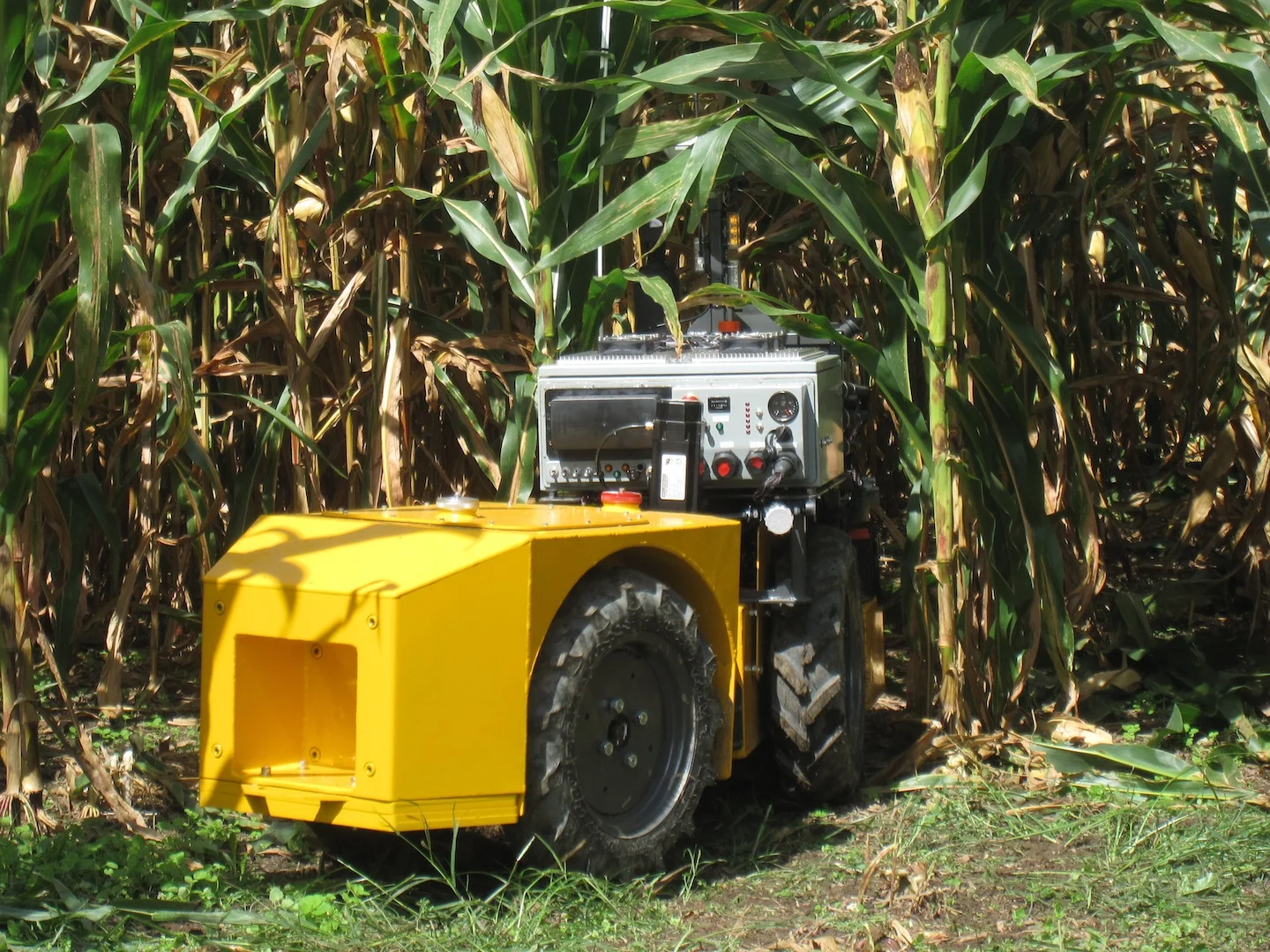
A recent post on AgFunder's blog captures the founding story behind Rowbot nicely. We believe Cori Capik's use of the term RaaS (robots as a service) will be seen as quite prescient as an analogy to SaaS (software as a service). We see RaaS as a powerful model for managing crops in the 21st Century.

Rowbot featured in Minnesota Business
An article featuring the Rowbot story just came out in Minnesota Business. We added a comment down at the bottom to clear up a confusing part of the article dealing with why many growers do not manage nitrogen during the season (it isn't about the fragility of the plants...it's that a rapidly growing crop creates size-related challenges for getting on the field with today's equipment). Our innovation is to remove the height of the crop from the equation...

Rowbot founding team (left to right): Charlie Bares, Kent Cavender-Bares, and John Bares.
Rowbot advances to finalist in Minnesota Cup
Earlier this week, Rowbot was selected as a finalist in the MN Cup, a yearly competition designed to identify breakthrough ideas in the Minnesota startup community! Rowbot is competing now against two other companies in the energy and cleantech division. We are one of 18 finalists in the overall competition out of nearly 1,100 entrants.

Rowbot selected as semifinalist in Minnesota Cup
We just learned that Rowbot was selected as a semifinalist in the MN Cup, a yearly competition designed to identify breakthrough ideas! Rowbot is competing in the energy and cleantech division. We are one of 57 finalists in the overall competition out of nearly 1,100 entrants.

Rowbot selected as semifinalist in 2013 Cleantech Open

We are excited to have been selected to take part in the 2013 Cleantech Open accelerator program.
About The Cleantech Open
The Cleantech Open runs the world’s largest cleantech accelerator. Its mission is to find, fund and foster entrepreneurs with big ideas that address today’s most urgent energy, environmental and economic challenges. A 501(c)(3) not-for-profit organization, the Cleantech Open provides the infrastructure, expertise and strategic relationships that turn clever ideas into successful global cleantech companies. Since 2006, through its one-of-a-kind annual business competition and mentorship program, the Cleantech Open has enabled 727 cleantech startups to bring their breakthrough ideas to fruition, helped its alumni companies raise more than $800M in external capital, and created thousands of green-collar jobs. Fueled by a global network of more than 1,500 volunteers and sponsors, the Cleantech Open unites the public and private sectors in a shared vision for making America’s and the world’s cleantech sectors a thriving economic engine. For more information, visit www.cleantechopen.org, or follow us on Twitter and Facebook.
Cornell's Adapt-N: A tool for determining corn's nitrogren needs during the season
Today, I listened in to the excellent overview during an in-depth training session run by the Adapt-N team at Cornell. The team made a compelling case for the many benefits of in-season nitrogen application. Specifically, in-season applications are a key to responding to constantly-changing nitrogen needs of a particular field. This was perhaps best explained by a graph showing the increasing predictability of a crop's nitrogen need as the season progresses. The underlying rationale is that, with each day further into the season, there's less chance for significant weather events that will lead to nitrogen loss.

National No-Tillage Conference

The speaker line up here at the National No-Tillage Conference (NNTC) is super and the first day's program was excellent. Lots of discussion related to improving soil health through no-till. An evening session on cover cropping was particularly good with lots of advice on how to work cover crops into a no-till crop rotation program.
Dan Towery discussed how incorporating cover crops is truly a journey that can take many years--say 15--to reach what he calls the maintenance phase. He thinks of it in four phases:
- phase 1 (initialization: soil structure improves, though additional nitrogen may be needed for the cover crops initially)
- phase 2 (transition: organic matter is accumulating, microbial activity increases, phosphorus accumulates, and nitrogen is immobilized, plus there's more N mineralization)
- phase 3 (consolidation: more organic matter accumulates, more water is available in the soil, cation exchange capacity (CEC) increases, and nutrient cycling is improved)
- phase 4 (maintenance: a continuous flow of N and C in the soil, greater water availability, high nutrient cycling, with increases in N and P)
Eileen Kladivko, an agronomist at Purdue, in a super talk walked the audience through the decision matrix for selecting a cover crop mix. She mentioned a cover crop decision tool offered by the Midwest Cover Crops Council (MCCC). This is a very powerful tool that can help demystify the many considerations involved in determining what cover crop system is best in a particular situation.


How Will In-Season Management of Corn Be Impacted By Narrower Row Spacing?

Spent some time this week attending the Minnesota Crop Production Retailer's conference here in the Twin Cities. There were many of the same themes that permeated last month's North Central Extension-Industry Soil Fertility Conference, including plenty of discussion about getting the 4Rs right: right fertilizer, at the right rate, during the right time window, and in the right place.
There was a talk by Jeff Coulter of the University of Minnesota Extension discussing recent research on corn plant populations. A broad trend toward narrower rows is going to make in-season management, including sidedress nitrogen applications, much more challenging. There are trade-offs in every management choice, and it will be interesting to see how the advantages of shifting row spacing stack up against reduced in-season management options.
Thoughts?
Ag Engineering Expert's View: Autonomy Is the Answer
Dr. Scott Shearer, the chair of the Food, Agricultural and Biological Engineering Department at Ohio State University, lays out his arguments for the role of autonomy in agriculture in this video. Specifically, he argues that small, autonomous tractors will be the key to reducing soil compaction caused by ever-larger tractors. I had the pleasure of meeting with Dr. Shearer this past week.